SEO Services in Springfield, Missouri
If people are searching for what you sell and finding someone else, that is a fixable problem. No jargon, no lock-in, and a scope you can actually read. You will know what is being done, why, and what it costs before anything starts.
What search engine optimization actually is
Stripped of the mystique, SEO is three things. Your site has to work properly so Google can read it. Your pages have to be about something specific that people search for. And other websites have to point at you, because that is how Google decides you are worth trusting.
Everything below is one of those three. If an agency ever describes their work and you cannot place it into one of those buckets, ask harder questions.
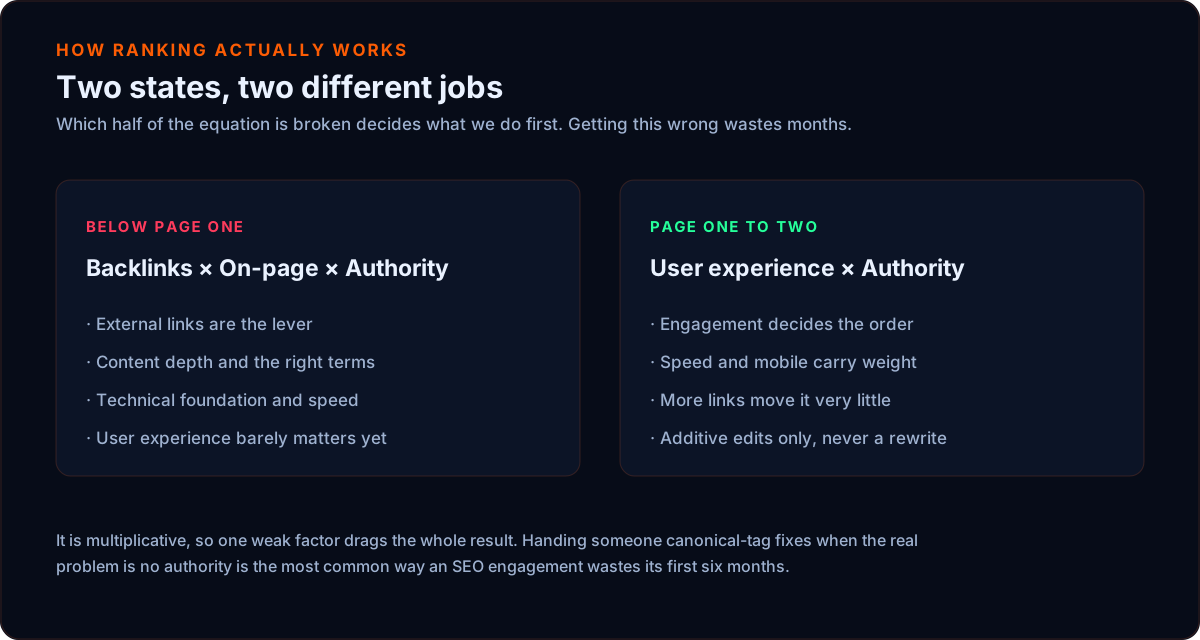
The technical SEO audit comes first
There is no point writing new pages onto a broken foundation. A technical SEO audit crawls the whole site and finds the things quietly stopping it from ranking, and on most small business sites, it finds something significant.
Pages Google cannot index
The worst and most common finding. A page carrying a noindex tag is invisible no matter how good it is. We have opened audits where a client's main service pages were all switched off by accident.
Duplicate and missing titles
Two pages claiming the same topic compete with each other and neither wins. Missing titles let Google invent one for you, usually badly.
Speed and mobile problems
Mobile SEO is not a separate service. It is most of your traffic. Slow, cramped pages lose visitors before they read a word.
Broken links and redirects
Dead internal links waste the authority your site already has. Chains of redirects leak it. Both are unglamorous and both are free to fix.
Schema markup
Structured data tells Google what a page is rather than making it guess: your services, your reviews, your questions and answers. It is a quick win that most sites simply do not have.
A free website audit first
You get the findings before you commit to anything, in language you can act on. If the answer is that you do not need us, we will say so.
Keyword research, then on-page work
Keyword research is not a list of words. It is deciding which searches are worth chasing: the ones with real intent behind them, at a difficulty your site can realistically reach. Aiming at terms owned by national brands with twenty years of history is how budgets disappear.
A competitor SEO analysis tells us what that bar looks like. We read the pages already ranking for your terms and work out what they have that you do not: more depth, better structure, more sites linking to them, or simply a page on the subject at all.
On-page optimization is then the unglamorous part that moves the needle: one clear topic per page, titles and headings that say what the page is, internal links that connect related pages, and content deep enough to answer the question properly rather than gesture at it.
Content and links, the two things that compound
Content that answers the question
SEO copywriting for local businesses is not stuffing a phrase in twelve times. It is covering a subject well enough that a reader gets what they came for. Content optimization does the same for pages you already have, usually faster and cheaper than writing new ones.
Blog and supporting content
Articles exist to answer the questions your customers ask before they buy, and to give your service pages something relevant to link from. Blog SEO is not about publishing weekly. It is about publishing things worth reading.
Backlink building
Other sites linking to yours is roughly half of what decides rankings, and it is the half most people skip because it is slow. Off-page work means earning those links: sponsorships, local press, genuine relationships, not buying a thousand junk ones.
Content and links are the two things that keep paying after you stop. Technical fixes are one-time. This is the part that compounds, and the reason SEO is measured in quarters, not weeks.
Local, national, or something more specific
Not every business needs the same thing, and paying for the wrong one is a common way to waste a year.
You serve a town or a radius
Then most of your opportunity is in the map results, not the blue links below them. That is a different discipline with different levers. See how businesses win the map pack, and if you are south of Springfield, what that looks like in Nixa specifically.
You sell anywhere in the country
National SEO is a longer game against stronger competition. It leans much harder on content depth and earned links, because there is no proximity advantage to fall back on.
You sell products online
Stores have their own problems: category pages, product pages and filters that create thousands of near-identical URLs. That needs handling differently.
If you need traffic before organic search has had time to work, paid search can bridge the gap while the slower work compounds. We usually reduce ad spend as rankings arrive rather than running both forever.
Specialized SEO services in Springfield
SEO Audit
Want the findings before you commit to anything else? Get a Springfield SEO audit that lists exactly what is broken and what to fix first, in plain language.
Mobile SEO
Most of your visitors are on a phone before they ever touch a desktop. Our mobile SEO services fix the load times and layout problems that lose them before they read a word.
SEO Consulting
Already have a marketing team or an in-house webmaster? Book SEO consulting and we will point them at the right priorities instead of guessing.
Custom WordPress Website
A site built on a template fights you at every turn. A custom WordPress build is built around your content and your keywords from the first line of code.
The questions worth asking any SEO company
How long until it works?
Three to six months before it is worth discussing, longer on a new domain. Impressions move before phone calls do. Anyone promising page one in a month is guessing.
What does it cost?
You get an itemized scope: pages, words, links, fixes, not a flat number with nothing attached. If you cannot see what you are buying, you cannot tell whether you got it.
Can I do it myself?
Some of it. Your Google Business Profile, honest page titles and consistent contact details cost time, not money. The technical work and earning links is where experience and tools matter.
How will I know it is working?
Non-branded rankings and inquiries. Anyone can rank for their own business name, and that proves nothing. We report on the searches where you were not already the answer.
Do I need SEO on every page?
Every page needs one clear topic and a reason to exist. Not every page needs active work. A handful drive most of the traffic and deserve the attention.
What if I leave?
The work stays on your site because it is your site. No proprietary plugin holding your content hostage, no rankings that evaporate the day you stop paying.
SEO and AI search optimization are now two jobs
People are increasingly asking ChatGPT and AI search instead of typing into Google. Those systems pick businesses differently: they ignore backlinks, they lean on mentions, reviews and schema, and for local questions they lean heavily on Bing rather than Google search. You can rank first in Google search results and be completely absent from an AI answer.
AI search optimization is therefore not a rebranding of SEO strategies you already have. It is a separate checklist: a complete Bing listing, unlinked brand mentions in directories and forums, review content specific enough to be quoted, and heavy schema. Most SEO companies in the Springfield market are not looking at this at all yet, which is exactly why it is worth doing now.
The traditional work still matters and still comes first. Technical fixes, content strategy, on-page optimization and links are what earn search visibility in Google. But if nobody is checking whether AI tools recommend you, half the question is going unanswered.
SEO services in Springfield, MO, and beyond it
For a business serving the Springfield local market, most of the opportunity is not in the blue links at all. It is in Google Maps and your Google Business Profile, the listing that appears before anything else. Local SEO services, directory and citation consistency, and Google Business Profile optimization usually move the needle faster than anything you can do to the website itself.
We use the same tools everyone serious uses: Search Console for what is really happening, Semrush and Ahrefs for competitive research. But the tools are not the service. Reading them correctly and choosing what to do next is. Any marketing team can hand you a dashboard; fewer can tell you which two things on it matter this month.
Springfield businesses competing outside the region need something different again: deeper content, more earned links and patience, because there is no proximity advantage to lean on. We will tell you which of the two you actually are before you buy anything. Search is rarely the only lever either. It usually sits alongside the other marketing channels a Springfield business can pull. If those customers are starting their search inside an AI assistant instead, that is how AI search visibility is won in Springfield.
What clients actually say
Rated 5.0 on Google. Every quote below is a real customer review on our public Google profile.
"Joseph is brilliant and gets results. He has been managing my SEO for over 4 years and my business has increased significantly with the online presence. I get calls daily from customers finding me online, which was rare before Joseph started."
"Joseph at 417Boom is the real deal! If you need SEO or web design help in Springfield, he’s your guy. He helped us skyrocket our local GMB visibility in California, bringing in a ton of new traffic. I usually wait to see results before leaving a review, but dang!!! Joseph and his team know their stuff! …"
"I didn't know anything about SEO but yes I contacted Joseph and he immediately responded to me. I sent my google page and he made an awesome video explaining how to improve my business page. He is the best what he does, very knowledgeable! Great service !"
SEO questions we get asked
How long does SEO take to work?
Expect three to six months before the results are worth talking about, and longer on a new domain. Anyone promising page one in a month is either lucky or lying. The first movement usually shows in search impressions well before it shows in phone calls.
How much do SEO services cost?
It depends on how competitive your market is and how much content the site needs. You get an itemized scope: how many pages, how many links, what gets fixed, rather than a flat monthly number with nothing attached to it.
Can I do SEO myself?
Some of it, yes. Filling out your Google Business Profile properly, writing honest page titles and getting your address consistent everywhere costs nothing but time. The parts that take tools and experience are technical fixes, competitive keyword research and earning links.
What is a technical SEO audit?
A crawl of the whole site looking for the things that quietly stop pages ranking: pages Google cannot index, duplicate titles, slow loading, broken links, missing structured data. It is the first thing we run because there is no point writing new pages onto a broken foundation.
Do I need SEO on every page?
Every page needs a clear title, one clear topic and a reason to exist. Not every page needs active optimization. A handful of pages usually drive most of the traffic, and those are the ones worth real attention.
Want to know what is actually wrong?
Get a free audit of your site and a plain-English list of what to fix first.