How Long Does Local SEO Take? An Honest Local SEO Timeline for Springfield MO
2026-08-15
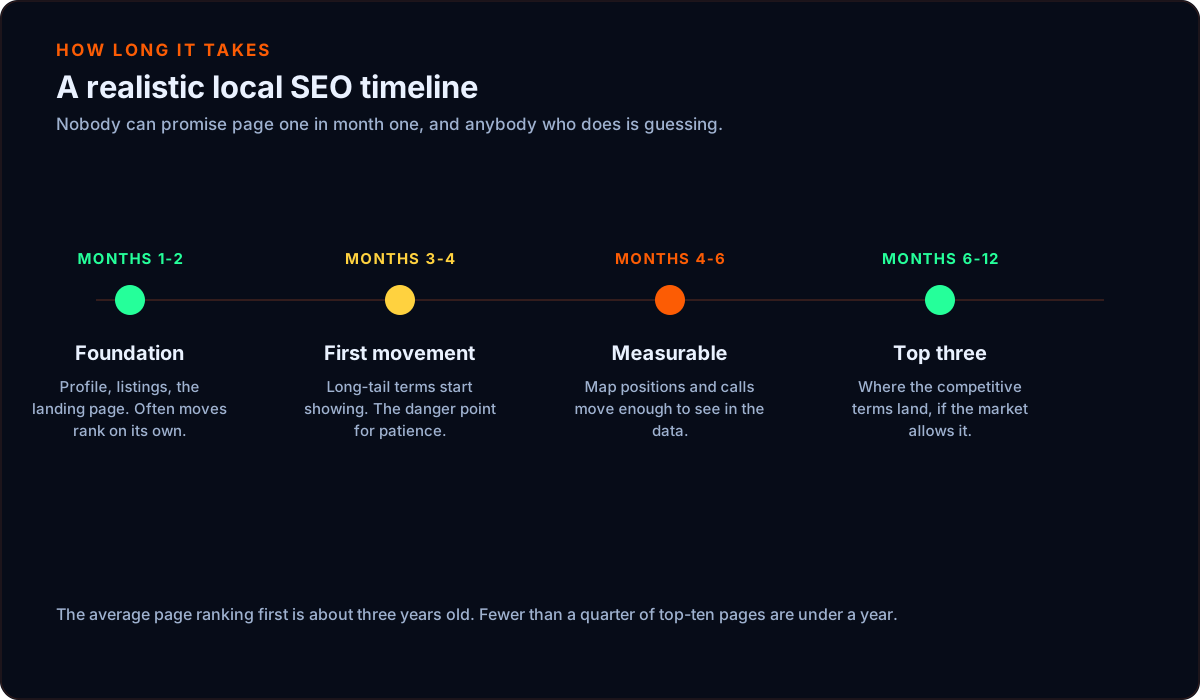
Local SEO usually takes four to six months to produce results you can see, and 6 to 12 months to show results that hold in the top three of the map pack. Google says an SEO needs four months to a year to implement improvements and then see the benefit.1 A brand new website takes longer. Local visibility, profile views and calls almost always move before the ranking does.
What Does Google Actually Say About How Long SEO Takes?
“How long does SEO take?” is the first question almost every business owner asks. In Google’s own video on hiring an SEO agency, the company says an SEO needs four months to a year to first implement improvements and then see the benefit.1 Remember that the next time somebody promises page one in thirty days.
Google’s starter guide for site owners puts it a second way. Some changes might take effect in hours, others could take months, and you should wait a few weeks before judging whether your SEO efforts worked.2 Google also warns nobody can guarantee a number one position, so any SEO campaign sold on a guaranteed ranking is selling something Google says does not exist.7
There is a mechanical reason for the delay. Nothing you publish works until search engines crawl and index it, and Google says crawling can take days to weeks, with no guarantee of inclusion.3 The clock starts when Google sees the page, not when you publish.
What Does the Local SEO Timeline Look Like Month by Month?
Averages are useless if you cannot tell whether your own campaign is on track. Here is what a healthy local SEO timeline looks like from the inside.
Month One: Foundation, Not Fireworks
The first month is setup. You complete the Google Business Profile, fix categories and services, rebuild the landing page around the right keyword, and clear technical SEO problems such as slow pages, broken pages and pages blocked from indexing. You will rarely see movement in the rankings, and that is normal.
One exception is worth knowing. If the profile was badly incomplete, fixing it alone can produce results within weeks. Google states plainly that businesses with complete and accurate information are more likely to show up in local search results.4 That is the cheapest win available, which is why you optimize the profile before you optimize a single page, starting with a properly completed and categorized business profile.
Months Two and Three: The First Movement
This is where you start seeing small signals rather than big wins. New pages get indexed. The profile collects more views and calls. Rankings begin moving on the grid closest to the business, because distance is one of three things Google uses to rank local results.4 Keywords that were nowhere appear on page three of the search results.
Nobody celebrates page three, but movement from unranked to ranked is the most reliable early sign that the work is delivering results, and it shows up long before the phone does.
Months Four to Six: Where Local SEO Results Show Up
This is the window where most businesses start seeing results they can feel. Service pages settle into the top ten of the search engine results pages, map pack visibility widens beyond the block next door, and lead volume becomes visibly different. It lines up with the four month mark in Google’s stated range.1
It also matches how the work compounds. Content from month one has been crawled, indexed and evaluated, backlinks have aged, and reviews have accumulated. Google says more reviews and positive ratings can help local ranking.4 Those signals take time to build, which is the real reason SEO takes time at all.
Months Seven to Twelve: Holding and Widening
By this stage the goal changes. Reaching the top three is one job, staying there while competitors react is another. Rankings wobble before they settle, so a position bouncing between two and five in month seven has not failed, it has not stabilized. Noticeable results at the outer edges of your service area take longer, because out there you no longer win on distance.
What Are the Key Factors That Affect Local SEO Speed?
Two businesses can run identical SEO strategies and get results months apart. These are the key factors that explain the gap.
How Old and Established the Website Is
Age is the factor most people underestimate. An analysis of 1.3 million keywords found the average number one ranking page is around five years old, 72.9% of top ten pages are over three years old, and only 13.7% are under a year old.5 Fewer than 2% of new pages reached the top ten within twelve months.
A new website can still win locally, because the map pack plays by partly different rules than the organic search results. But a brand new domain should expect the long end of the timeline, and any promise of instant results is a red flag.
How Competitive Your City Is
Ranking in a town of 15,000 is a different sport than ranking in a metro of two million. In a low competition market, a complete profile and a handful of well written pages can reach the top three in a few months. Where every competitor has an optimized website, hundreds of reviews and real backlinks, the local SEO timeline stretches toward a year.
How Complete the Google Business Profile Is
According to Google’s published guidance on local ranking, results on Google Maps and in local search are based mainly on relevance, distance and prominence.4 You cannot change how far your building sits from the searcher, so relevance and prominence are the levers you control. Relevance comes from a complete profile and content that matches the search. Prominence is built from reviews, mentions and links over time, and there is no way to pay for a better local ranking.4
How Much Work Is Actually Being Done
A campaign publishing eight pages a month and earning links every month will outrun one publishing two pages a quarter. When someone tells you local SEO takes 6 to 12 months, ask what volume that assumes. The timeline is not a law of nature, so how you approach SEO changes the answer as much as your market does.
Can You Speed Up Local SEO and Get Faster Results?
You can compress the timeline, but only in specific ways.
- Fix the profile first. Complete every field, choose the right primary category, list every real service. It is the fastest lever and it costs nothing.
- Clear technical blockers early. Pages that are not indexed cannot rank, however good they are. Finding them in week one instead of month five saves months.
- Publish more, sooner. Front loading content means it starts aging immediately, and age is what you cannot buy later.
- Ask for reviews from day one. Reviews influence both ranking and whether anyone clicks you once you rank.
- Build authority deliberately. Sponsorships, chamber memberships and genuine local coverage produce the backlinks that move prominence.
What you cannot do is skip the waiting. Search engines evaluate sites over time on purpose, so every tactic that promised faster results by bypassing that period has eventually turned into a penalty.
How Do You Measure SEO Progress Before Rankings Move?
Rankings are a lagging indicator, so judging a campaign at month two will always look like failure. Free tools such as Google Search Console show movement long before the money keyword does. Watch indexed pages, how many keywords you rank for at all, profile views and calls, and how far from your address you hold a top three position. All moving the right way means progress is real.
Common SEO Questions About Local SEO Timelines
How Long Does SEO Usually Take?
Four months to a year for meaningful results, according to Google.1 Local SEO often lands at the faster end because the map pack rewards profile completeness and proximity, not just domain authority. National and ecommerce search engine optimization usually runs longer.
How Long Does It Take to See Results From Local SEO Services?
Most businesses see results they can measure between months three and six, and significant results between months six and twelve. Results arrive sooner in a low competition town and later in a crowded metro, so ask any provider what their estimate assumes.
Is Local SEO Worth It for Small Businesses?
It comes down to whether you can realistically reach the top three of the map pack, because visibility falls off a cliff below that. If your market is winnable, local SEO puts you in front of someone nearby at the moment they are ready to buy, which is rare in digital marketing. If it is not winnable, paid advertising is the more honest answer.
What Is the 80/20 Rule in SEO?
It is shorthand, not a Google rule. The idea is that a small share of the work drives most of the SEO success, so you do that part first. In local SEO strategies the high leverage 20% is usually the business profile, the main landing page, indexing and reviews.
Is SEO Dead Now With AI?
No, though what you measure is changing. Google’s guidance on its AI features says you do not need new machine readable files or special structured data to appear in them, and that improving performance means focusing on fundamentals rather than shortcuts.6 For a local business, AI answers about nearby services lean on the same profile data, reviews and local signals that drive the map pack.
How Long Does Local SEO Take to Work on a Brand New Website?
Plan on nine to twelve months for a new domain, sometimes longer in a competitive city. The profile can start ranking sooner, which is why a new business should treat local search as the priority and let the website earn its authority behind it.
What to Do With This Timeline
Local search is a long game. The businesses that win it are rarely the ones with the cleverest plan, they are the ones that kept going past month three, when the work was done and the results had not arrived. Understanding how long SEO takes is what makes month three survivable. Treat SEO as a compounding asset rather than a monthly bill, because local SEO is an ongoing process, not a project that finishes.
To learn how long local SEO takes in your own market rather than in the average one, start with what is holding the site back today. That means a diagnostic audit of your site and profile to see whether the problem is indexing, content or authority, then a plan for earning the local links that build prominence. If you would rather hand it over, here is how a full local search program works from month one to month twelve.
Call or text 417-619-5056 for a straight read on what your market realistically takes, serving Springfield, MO and the surrounding communities.
Sources
- 1. Google Search Central, “How to Hire an SEO” (Maile Ohye). https://www.youtube.com/watch?v=piSvFxV_M04
- 2. Google Search Central, “SEO Starter Guide: The Basics.” https://developers.google.com/search/docs/fundamentals/seo-starter-guide
- 3. Google Search Central, “Ask Google to Recrawl Your Website.” https://developers.google.com/search/docs/crawling-indexing/ask-google-to-recrawl
- 4. Google Business Profile Help, “Tips to Improve Your Local Ranking on Google.” https://support.google.com/business/answer/7091
- 5. Ahrefs, “How Long Does It Take to Rank in Google? And How Old Are Top Ranking Pages?” https://ahrefs.com/blog/how-long-does-it-take-to-rank-in-google-and-how-old-are-top-ranking-pages/
- 6. Google Search Central, “AI Features and Your Website.” https://developers.google.com/search/docs/appearance/ai-features
- 7. Google Search Central, “Do You Need an SEO?” https://developers.google.com/search/docs/fundamentals/do-i-need-seo
Read more about our local seo work.
Joseph Vang
Founder & SEO Strategist, 417BOOM
Joseph runs 417BOOM, a veteran-owned internet marketing agency in Springfield, Missouri. He works on local search, Google Business Profiles and the content that gets small businesses found. More about Joseph.