Digital Billboard Advertising in Springfield, MO
A board on I-44 reaches the same drivers who search for you later that week. We plan the routes, buy the faces, build the creative, and measure the lift in your search data instead of handing you an impressions figure nobody can act on.
What digital billboard advertising actually buys you
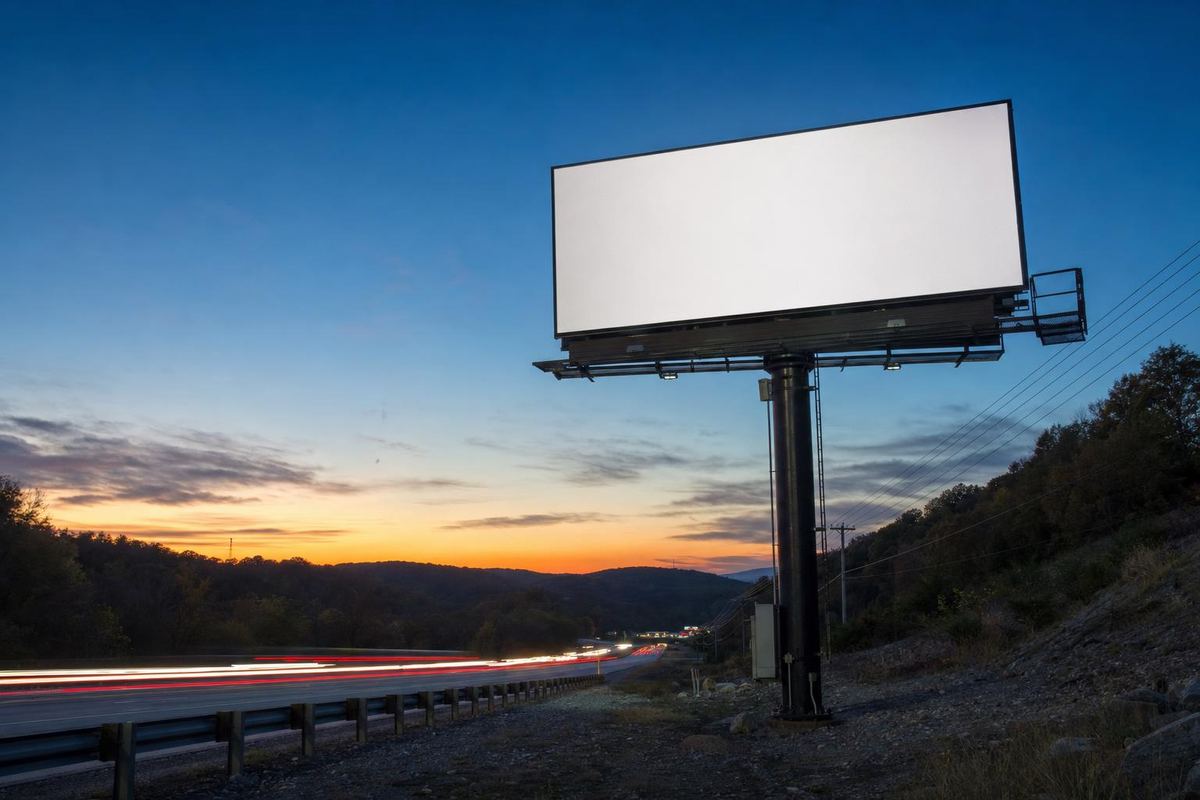
A digital billboard is a lit screen on a structure beside a road, running your artwork in a rotation with a handful of other advertisers. Each advertiser holds the face for roughly eight seconds before the loop moves on, which means your creative is seen many times a day by the same commuters rather than once by a stranger.
That repetition is the whole product. Outdoor advertising does not work like paid search, where somebody types a need and you answer it. It works by making your name familiar before the need exists, so that when the water heater fails or the roof leaks, yours is the name already in the room. Billboard advertising in Springfield is a memory purchase, not a click purchase, and it should be bought and measured that way.
The Springfield billboards worth buying
Not every board is worth the rate card. These are the corridors that carry real local traffic rather than through traffic that will never call you.
Interstate 44
The heaviest count in the region and the most expensive faces. Strong for brand building and for catching traffic moving between Joplin, Springfield and St. Louis. Weaker for a neighborhood service business, because a large share of those drivers are not local.
James River Freeway, U.S. Route 60
The commuter route for south Springfield, Battlefield and Republic. This is usually the better buy for a local trade, because the same vehicles pass the same board twice a day, five days a week.
Glenstone and Kearney
Retail and surface-street traffic at lower speed, which means longer dwell time on the board and room for one extra word. Good for storefronts, restaurants and anything with a physical address worth naming.
U.S. Route 160 toward Nixa
The Christian County commute. Worth buying when your service area runs south, and the natural pairing with a Nixa-targeted landing page rather than a general homepage.
Campus and Bass Pro corridors
Missouri State University traffic and the visitor flow around Bass Pro Shops. Seasonal, young-skewing, and effective for the businesses that genuinely serve those audiences rather than everyone who wants the impressions number.
The Branson run
Boards aimed at visitor traffic heading south. A different audience entirely, and only worth the spend if you actually sell to people passing through the Ozarks rather than to people who live here.
A digital bulletin in a good corridor beats a bigger board in a bad one. We pick faces against where your customers already live and drive, not against the impressions figure on the rate card.
Static and digital boards do different jobs
Outdoor advertising, the industry calls it OOH, splits into two kinds of billboard inventory and advertisers routinely buy the wrong one. A static bulletin is printed vinyl and yours alone for the whole period, so it is seen every single time a driver passes. Digital bulletins share the face in a loop, so you are seen roughly one pass in six, but you can change the artwork the same day and buy shorter runs.
Static wins when the message never changes and the corridor is one your target audience drives daily. Digital wins when you want to test creative, run a seasonal offer, or start without committing to a printed run. For most local advertisers in the Springfield DMA the honest answer is one strong static face for the year plus digital billboard faces layered on for pushes.
Vendors quote both against traffic counts and sometimes a CPM figure. Treat CPM carefully on a board: it counts vehicles passing, not people who looked. Billboard coverage across a route matters more than the cost per thousand on any single face.
The types of billboards you can buy around Springfield
Advertisers usually say billboard and mean one thing. The trade sells several, and the types of billboard advertising differ in size, in what they cost, and in who drives or walks past them. Picking the wrong format is the quietest way to waste a quarter of spend.
Bulletins
The large format people picture, roughly 14 by 48 feet, placed along highways and the heaviest commuter routes. A bulletin is a single advertiser on a single billboard structure, so your artwork is the only thing on that face for the whole buy. Advertising space is sold per four-week period, not per calendar month.
Digital bulletins
Same size and the same high-traffic areas, lit by LED. Several advertisers share one display on a rotating loop, so your share of voice decides your real exposure. You gain the ability to change artwork in real time and to run different messages by time of day.
Posters
Around 12 by 25 feet, the traditional billboard of surface streets rather than interstates. Lower cost per display and closer to the customer, which suits a business whose trade area is a few neighborhoods rather than the whole region. Speeds are lower, so a driver has longer with your message.
Junior posters
Roughly 6 by 12 feet, placed in urban areas on neighborhood streets and near shopping. These reach pedestrian traffic as well as slow vehicle traffic, and they are the cheapest way into outdoor advertising for a single-location business.
Wallscapes
Vinyl mounted to the side of a building rather than a freestanding structure. Rare here, concentrated downtown, and priced on the landmark value of the wall rather than a traffic count. Worth asking about only if the wall happens to face your customers.
Mobile billboards
Advertising displays mounted on a truck that drives a route you choose. Useful for an event, a grand opening or a single weekend, and poor value as a standing campaign, because you are paying for the vehicle and the driver as well as the space.
For most local advertisers in this market the honest shortlist is two items long: a digital bulletin on the corridor your customers commute, or a static bulletin if you would rather hold one face for the whole four weeks than share a loop.
Where billboards fit against other forms of advertising
Billboards belong to out-of-home advertising, which is simply the trade name for anything that reaches people while they are out rather than at a screen. Knowing what else sits in that category tells you what a board is genuinely good at.
The rest of out-of-home is transit advertising, bus shelters and benches, airport and arena placements, and signage inside shopping centers. Each one narrows the audience. A bus shelter reaches the people at that stop. An arena placement reaches people who bought a ticket. A billboard does the opposite: it reaches everybody on a route, whether they wanted it or not.
That breadth is the whole argument for the format and the whole argument against it. If your target audience is most households in the county, paying to reach everyone is efficient. If you serve one narrow slice of the population, you are buying ninety-something percent waste, and search will do the job for a fraction of the money.
The other thing a billboard cannot do is capture. A board creates demand and hands it to whoever is easiest to find when the person eventually searches. Which is why we will not sell a billboard advertising campaign to a business whose Google Business Profile is stale and whose site takes eight seconds on a phone. Fix those first, then buy the board, and the same spend produces a measurable lift instead of an impressions report.
If you are searching for billboard advertising near you and comparing operators, ask each one the same question: what proportion of the traffic on this structure starts or ends inside my service area? A vendor who has thought about it can answer. One who cannot is quoting you the road.
Billboard design, production costs and what you are really paying per impression
Media is only part of the invoice. Every billboard campaign carries a second line for artwork, and on static faces a third for print and installation. Advertisers who budget for billboard space alone get surprised twice.
Billboard design is a specific discipline, not a resized social graphic. The practical design tips are short: one idea per face, a font heavy enough to read at distance, and contrast strong enough to capture the attention of somebody who is not looking for you. An eye-catching board at arm's length can vanish at four hundred feet, which is the only distance that matters.
Production costs split by format. A digital ad is a file, so there is nothing to print and changes can be pushed in real time. Traditional static billboards need vinyl printed to that structure's exact dimensions and a crew scheduled to hang it, which is a separate cost with its own lead time and its own weather risk. That difference is often what closes the gap between static and digital billboards once you compare full quotes rather than headline rates.
On billboard advertising costs, the figure worth calculating is not the monthly rate. Take the cost per four-week period, divide by your share of the loop, then divide again by the share of that traffic which plausibly lives or works in your service area. What you get is your real cost per impression, and it is a far smaller and far less flattering number than the one on the proposal. It is also the only number that compares one structure honestly against another.
Rates vary between media companies on the same road, so the average cost of billboard advertising published nationally tells you very little about this market. The Out of Home Advertising Association of America publishes format standards and measurement definitions that are useful for checking a vendor is quoting what you think they are quoting.
Traditional billboard advertising still works here, and for some advertisers a static bulletin beats a digital one. Holding a single face for the full period buys uninterrupted visibility, where digital advertising trades that away for flexibility and a lower entry price. Neither is better. They answer different questions.
What Springfield billboard advertising rates look like
Rates are quoted per face, per four-week period, and they move with traffic count, board size and how many advertisers share the loop. In this market a digital face typically runs from the high hundreds to a few thousand dollars per period, with I-44 at the top and surface streets at the bottom. Production is cheap on a digital board because there is nothing to print.
Two things change the number more than anything else. Buying several faces together costs less per face than buying one. And buying at the last minute costs more than committing to a run, because unsold inventory gets discounted but good corridors sell out early in the quarter.
We quote the board cost and our fee separately, so you can see what the media costs and what the work costs. An advertiser who cannot see that split cannot tell whether they are being marked up.
Artwork that works at sixty-five miles an hour
The single most common waste in outdoor advertising is a board designed on a monitor and never tested at distance. A driver has about six seconds and a slice of peripheral vision.
Seven words, maximum
Count them. Your name, what you do, and one reason to remember it. Every word past seven is a word nobody finishes reading. A phone number on a highway board is wasted space, because nobody is writing it down at speed.
Contrast beats color
At distance the eye resolves contrast long before it resolves hue. A light element on a dark field reads from further away than two mid-tone colors that looked bold on screen. This is why so many boards disappear at dusk.
One idea per face
Digital lets you rotate several creatives, which tempts advertisers into putting three offers on one board. Rotate them across separate artwork instead, so each face carries a single thought.
Name the place
A local business naming its town or its street converts better on a board than a national-sounding slogan, because the value you carry over a competitor is that you are nearby.
How we measure a billboard instead of guessing
Outdoor advertising has a reputation for being unmeasurable, and the reason is that most advertisers only ever receive the impressions estimate the vendor supplied. That number describes the road, not your campaign.
A billboard that is working leaves a fingerprint somewhere you can check. People who see your name and act on it later do not remember your website address. They search your business name, or your name plus your service. That shows up as a rise in branded searches in Search Console, and it starts within weeks of a board going live.
So we take a baseline before the campaign starts, run the boards, and read branded search volume, direct traffic and profile views against that baseline. It is not a perfect attribution model and we do not pretend it is one. It is considerably better than an impressions figure, and it is the reason we will tell you when a board is not earning its rate.
This is also why billboards belong next to the search work rather than in a separate budget. The board creates the demand and the search results catch it, and if your local search presence is weak the demand lands on a competitor instead.
Digital billboard questions we get asked
How much does it cost to have an ad on a digital billboard?
In the Springfield metro, expect the high hundreds to a few thousand dollars per face per four-week period, driven by traffic count and corridor. Digital costs less to launch than a printed bulletin because there is no production or install.
Can I advertise on digital billboards as a small business?
Yes, and small local advertisers are a large share of the inventory. A single well-chosen face on a commuter route is a realistic starting point and usually outperforms spreading the same budget across several weak boards.
How do I get on a digital billboard?
Availability is bought from the operator that owns the structure, by face and by period. We handle the buy, the artwork to their specification, and the scheduling, so you are not negotiating with several operators separately.
How long before a billboard does anything?
Brand recall builds with repetition, so a two-week run rarely shows anything. Four to twelve weeks on a corridor your customers actually drive is the honest minimum, and we measure the branded search lift across that window.
Get rates and availability for your corridor
Tell us where your customers are and what you sell, and we will come back with the faces worth buying, what they cost per period, and what we would put on them. If billboards are the wrong spend for your business this quarter we will say so, which happens more often than you would expect from an agency that sells them.
More on billboard advertising in Springfield
The questions local advertisers ask most, answered properly.
How much does a billboard cost in Springfield?
Working rate ranges by corridor, the four things that move the number, and why CPM flatters the wrong boards.
How does billboard advertising work here?
Who owns the structures, how digital and static differ, and what actually happens between booking and going live.
How many billboards are in Springfield?
Why no exact count exists, why supply is fixed by permitting, and how to count the faces that actually matter to you.
How often will people see my board?
Real exposure math on a shared digital face, and why a four-week test ends exactly when the effect would start.
How far ahead should I book?
Lead times by format, what booking early actually buys, and the week-by-week sequence back from your live date.