How to Rank on ChatGPT: What Actually Gets You Cited
2026-09-26
You cannot rank on ChatGPT the way you rank on Google, because there is no ranked list to climb. ChatGPT answers a question by naming a handful of businesses or sources it considers credible, and everything else is invisible. Getting named comes down to three things: being present in the places ChatGPT pulls from, being mentioned by name across the open web, and publishing content structured clearly enough for a model to lift an answer out of it.
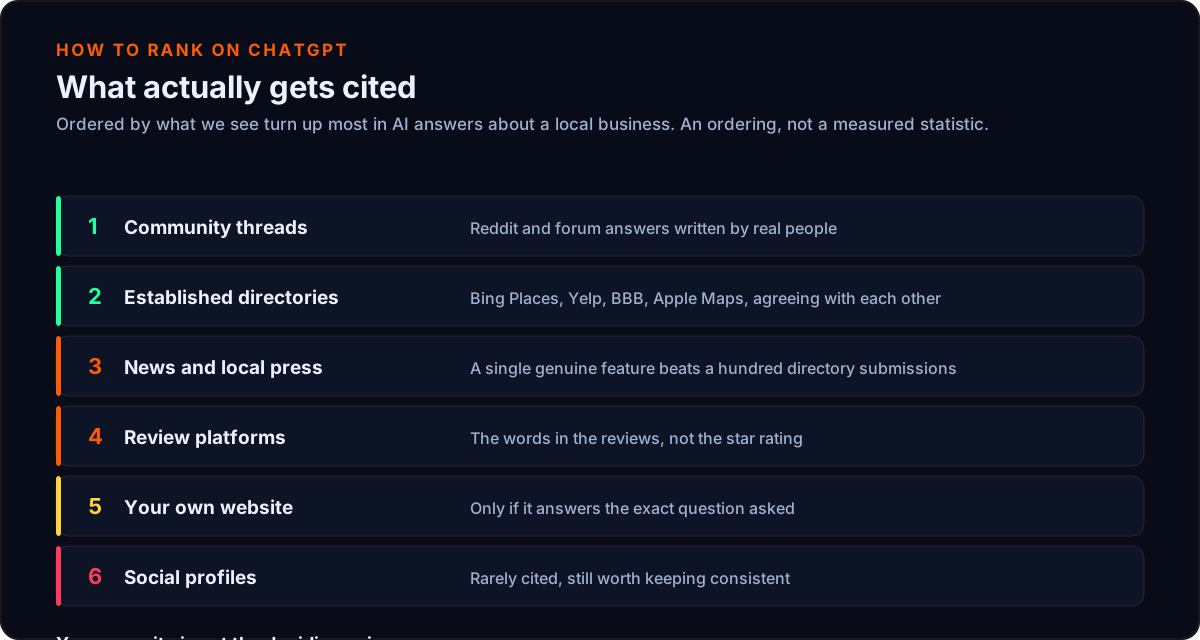
That is a different job from traditional SEO, and the uncomfortable part for anyone who has spent years on search is how much of the usual work does not transfer.
How ChatGPT decides which businesses to name
ChatGPT builds an answer from two pools. The first is what the model already absorbed during training, which is why it can name well-known businesses with no live lookup at all. The second is live search, used when a query needs current information, which returns a set of pages the model then reads and cites.
Both pools reward the same thing: being widely and consistently referred to. A business mentioned on twenty different sites in consistent terms looks real to a language model. A business that exists only on its own website looks like a claim.
This is the single biggest difference from Google. Google ranks pages. ChatGPT assembles a reputation and then answers from it.
ChatGPT search and traditional search engines are not the same product
When somebody uses a traditional search engine they get ten links and choose. When somebody asks ChatGPT, they get an answer and usually stop. There is no second position to settle for. Either your name is in the response or the query was worth nothing to you.
That changes the economics. On Google, position four still earns traffic. In an AI answer, being the fifth-best candidate earns nothing at all. Which is why chasing ChatGPT visibility is worth doing deliberately rather than hoping it arrives as a side effect of organic search.
It also means the query set matters. ChatGPT gets asked conversational, decision-shaped questions: who is good at this, what should I look for, is this worth the money. Those are the questions your content needs to answer plainly.
What does not work, and why so many SEO strategies fail here
Worth being blunt, because this is where budget gets wasted.
Backlinks carry far less weight. A language model is not running PageRank. Links help indirectly, because a linked mention is still a mention and links help pages get indexed, but buying links to rank in ChatGPT is close to spending for nothing.
Exact-match domains do nothing. Owning the keyword as a domain name is a traditional search tactic with no equivalent here.
Page speed and Core Web Vitals do not move the needle. They are worth fixing for human visitors and for Google. They are not what gets you cited.
Keyword density is irrelevant. The model reads meaning, not repetition. Stuffing a phrase makes the text worse for the humans who do arrive and buys no advantage with the model.
You can hold the number one organic position on Google and be entirely absent from ChatGPT answers about your own category. We have seen it on client audits more than once, and the businesses it happens to are usually the ones who did everything right by the old rules.
Get cited: the sources ChatGPT actually pulls from
When ChatGPT runs a live search, its citations skew heavily toward a few kinds of source. Community discussion, established directories, news and reference sites, and pages that answer the exact question asked.
Your own website is in that mix, but it is rarely the deciding factor, because a business describing itself is the weakest form of evidence available. What moves ChatGPT citations is other people describing you.
Why Reddit and Quora matter more than your backlink profile
Reddit is consistently among the most cited domains in AI answers, and Quora appears regularly too. The reason is structural rather than fashionable: these are places where real people answer questions in plain language, which is exactly the shape of content a model wants to quote.
The opportunity is obvious and the trap is just as obvious. Posting promotional comments from a fresh account gets removed, and it earns the kind of reputation that follows a small business around. What works is slower: a real account, used like a person uses it, answering questions in your field because you know the answer, with your business named in your profile rather than in every comment.
If you serve a local market, your own city's subreddit and local Facebook groups are where recommendation threads happen. Being the business other people name in those threads is worth more than anything you can publish yourself.
Brand mentions without a link still count
This is the part traditional SEO gets wrong by habit. We are trained to value a mention only when it carries a link. For AI visibility, an unlinked brand mention counts, because the model is building an association between your name, your category and your city, not following a citation graph.
So the practical list is wider than a link building list. Directory listings that agree with each other. Local news coverage. Association and chamber pages. Supplier and partner sites. Podcast appearances. Review platforms. Any place your business name sits next to what you do and where you do it.
Consistency matters more than volume. The same business name, address and phone written the same way everywhere gives a model one clean entity to recognize. Three variations give it three weak ones.
Bing, directories and the listings that feed AI answers
ChatGPT's live search has historically leaned on Bing's index, and OpenAI also runs its own crawler now. The practical advice has not changed either way: a complete, verified Bing Places listing is cheap, it takes twenty minutes, and most local businesses have never touched it.
Alongside it, the listings that repeatedly turn up inside AI answers about local businesses are Yelp, the Better Business Bureau and Apple Maps. Those four together are the baseline. If you only ever do one thing from this article, claim those.
Review content matters here in a way that surprises people. It is not the star rating, it is the words. A review that says which job was done, in which town, gives a model matchable language. Twenty reviews saying great service give it nothing.
Structured data and how to structure content for AI models
Structured data is the one piece of technical SEO that transfers cleanly. Schema tells a machine what your page is rather than making it infer. Organization, LocalBusiness, Service, FAQPage and Review markup, nested properly and validated, remove the guesswork.
How you structure content matters just as much. A few rules that hold up:
- Put the answer in the first sentence under each heading, then explain. Models lift clean, self-contained answers.
- Write headings as the question a person would actually ask, not as a clever label.
- Keep each section able to stand alone, because it may be read without the paragraphs around it.
- Use specific numbers, places and names. Vague copy gives a model nothing to quote.
- Add an FAQs block of genuine questions with direct answers.
None of this hurts human readers. Answer-first writing with honest specifics is simply better writing, which is a rare case of the optimization and the quality pointing the same direction.
Does high-quality content still matter?
Yes, and more than in traditional search, because there is no way to compensate with authority. A thin page can rank on Google on the strength of domain strength and backlinks. There is no equivalent prop in an AI answer. If the page does not contain a usable answer, it does not get used.
Depth, first-hand experience and real detail are what make content quotable. The pages of ours that get cited are the ones with specific local facts in them, not the ones with the best keyword coverage.
How to check your ChatGPT visibility right now
Open ChatGPT and ask it the questions your customers would ask. Who are the best roofers in your town. Which agency should a small business use for a particular job. What should somebody look for when hiring in your category.
Run each a few times, because responses vary between sessions. Note whether you appear, who does appear, and which sources get cited. That citation list is your target list: those are the pages and platforms the model trusts for your category, and getting mentioned on them is the work.
Do the same in Google's AI answers and in other AI platforms, because they draw on different sources and a business strong in one can be absent from another.
Does ChatGPT rank websites at all?
Not in the way the word usually means. ChatGPT does not rank websites into an ordered list, so there is no ChatGPT ranking to check and no position to report. What exists instead is a shortlist that changes with how the question is phrased.
Ask the same thing three different ways and you will often get three different sets of names. That is a property of how an LLM assembles an answer, not a bug to be gamed. It also means the goal is to appear in ChatGPT responses across a whole family of related questions rather than to rank well for one string.
The practical consequence: stop thinking about one keyword and start thinking about a topic. If you want to get cited by ChatGPT for your category, you need content and mentions covering the full set of questions a buyer asks, because you cannot predict which phrasing they will use.
Digital PR, fresh content and the rest of the ChatGPT SEO checklist
A few things sit outside the listings-and-schema work and still move ChatGPT visibility.
Digital PR does the heavy lifting. Getting written about, quoted or interviewed produces exactly the third-party mentions AI assistants are built to trust. For a local business this does not mean a national campaign. It means the local paper, an industry publication, a podcast, a supplier's case study page. One genuine feature is worth more than a hundred directory submissions.
Fresh content signals you still exist. Models and their search crawlers favor recent material for anything time-sensitive, and a site whose newest page is three years old reads as dormant. This does not require daily publishing. It requires that somebody who checks can see the lights are on.
Updating existing content usually beats creating new content. Most sites already have a page on the topic that simply answers it badly. Rewriting that page answer-first, adding the specifics and matching real search intent is faster than starting again and it keeps whatever authority the URL already has.
Google Search Console still tells you things. It cannot measure AI answers, which is a real blind spot worth being honest about with anyone who asks for a report. What it does show is which questions people already reach you with, and those questions are the best available guide to what to answer next.
Video counts. YouTube SEO is not a separate universe here. Transcripts are text, they get indexed, and a video that answers a question clearly can end up feeding an answer on platforms like ChatGPT the same way an article does.
AI tools help you check, not rank. There is a growing set of AI visibility trackers that sample AI responses at scale and report whether your brand appears. They are useful for measuring. None of them optimize anything, and any SEO agency selling a tool subscription as the service itself is selling you a thermometer and calling it medicine.
How long does it take to improve your ChatGPT visibility?
Faster than traditional SEO in one respect and slower in another. Listings, schema and rewritten pages can change what the live search layer finds within weeks. What the model absorbed during training moves on its own schedule and you cannot hurry it.
So expect the live-search half to respond inside a quarter and the reputation half to take longer, in the same way brand recognition always has. The businesses that get there first are the ones that treat AI citations as a category worth measuring now, while the cost of entry in a local market is an afternoon of listings work and better writing.
What we would do first, in order
- Claim and complete Bing Places, Yelp, the Better Business Bureau and Apple Maps, with identical details on each.
- Fix your Google Business Profile categories and services so the entity is unambiguous.
- Add Organization, LocalBusiness, Service and FAQPage schema, then validate it.
- Ask customers for reviews that name the job and the town.
- Rewrite your main service pages answer-first, with real questions as headings.
- Build a genuine presence where your market talks, then earn mentions rather than posting them.
It is unglamorous and most of it costs time rather than money. It is also the entire job, and almost nobody in a local market is doing it yet, which is the only reason it is still cheap.
This is the work we run as answer engine optimization and generative engine optimization, and it sits alongside the local SEO that still decides the map pack. If you want the whole picture, our AI marketing page lays out what we measure and what it costs.
Call or text 417-619-5056 and we will run your category through the AI platforms with you, serving Springfield, Nixa, Ozark and Republic.
Sources
- 1. OpenAI, "Overview of OpenAI crawlers." https://platform.openai.com/docs/bots
- 2. Google Search Central, "Structured data general guidelines." https://developers.google.com/search/docs/appearance/structured-data/sd-policies
- 3. Microsoft Bing Places for Business. https://www.bingplaces.com/
- 4. Schema.org, "LocalBusiness." https://schema.org/LocalBusiness
Joseph Vang
Founder & SEO Strategist, 417BOOM
Joseph runs 417BOOM, a veteran-owned internet marketing agency in Springfield, Missouri. He works on local search, Google Business Profiles, AI search visibility and the content that gets small businesses found. More about Joseph.