AI search judges a Kansas City business on reputation, not backlinks
When somebody asks an assistant to recommend a Kansas City business, no results page appears and no map loads. One answer arrives, naming two or three companies. How those names get chosen has almost nothing in common with how Google ranks pages.
Backlinks barely register. The thing that is roughly half of classic search engine optimization is close to irrelevant here. So is your exact match domain, and so is page speed.
Mentions count, even without a link. Being named in directories, local news, blogs and forum threads builds the picture these systems have of you. A mention with no link, which classic SEO treats as worth little, is worth a lot here.
Your reviews are read, not counted. The wording matters more than the star average, because a detailed review saying what you actually did can be matched to a specific question. Twenty generic five star reviews answer nothing.
Structured data does heavy lifting. Clear machine readable facts about what you do and where you do it. Google publishes guidance on how its own AI features use site content.1
Which is how a business can rank first on Google in Kansas City and be completely invisible to an assistant, usually for dull reasons: no Bing listing, no presence anywhere these systems quote, and reviews too generic to match a question.
What AI search optimization involves
Unglamorous and mostly about being findable in places classic SEO ignores.
Bing Places, first
Not optional. Several assistants read Bing's index, so a business missing from it is missing from their answers. It is free and it takes an afternoon.
Forum and community presence
Real participation under a real name in the places these systems quote, over months. Not posting links, which gets removed and does not work anyway.
Schema, heavily
Service, FAQ and organization markup so the facts about your business are machine readable rather than inferred from prose.
Reviews with detail in them
Asking customers what specifically you did, because that is the sentence an assistant can match to somebody's question.
Mentions and citations
Directories, local news and a monthly release. Brand entity signals that feed both Google and the assistants.
Measurement
Tracking whether you get named for the prompts your customers would actually type. Answer engine optimization and generative engine optimization are the two names this work goes by, and they describe the same job from different ends: being the source an assistant quotes, and being the business it names.
Nobody can promise you an AI ranking, including us
This page is more honest than most on the subject, so here is the part usually left out.
There is barely any search volume for this yet in Kansas City. Almost nobody is typing "ai seo kansas city" into Google. This is not a traffic page and we are not going to pretend it is. It exists because the behavior is real and growing even though the keyword is not.
The systems change constantly and are not transparent. Anyone selling you a guaranteed position in an AI answer is selling something that does not exist. What can be done is making your business the obvious thing to name, then checking whether it happens.
It is measurable, but not in Search Console. Assistant traffic mostly does not report there. Measuring it means testing the prompts directly and tracking how often you appear, which we do and report.
The realistic position: do the classic work properly, because it still pays today, and build the AI signals alongside because they cost little and the behavior is only moving one way. Both are on the Kansas City services page, and the search side is set out at Kansas City SEO services.
AI search visibility next to the search engine optimization you already know
The useful way to think about this is not old versus new. It is two audiences reading the same business and weighting different evidence.
What carries over. Clear structure, honest copy that answers a real question, complete and accurate business information, and a site that works. Every one of those helps in both places, which is why the sensible order is to do the classic work properly first. An SEO strategy that is sound is already most of an AI strategy.
What does not carry over. Links, largely. Exact match domains. Page speed as a ranking input. Keyword density. The technical SEO that earns you position four instead of position nine on Google does very little for whether an assistant names you.
What is new. Being quoted rather than ranked. AI platforms build an impression of your business from scattered mentions, the wording of reviews, directory entries and community threads, then produce one answer. There is no position ten to climb from. You are named or you are not, and that binary is what makes AI search visibility feel so different to work on.
What this means for a small business in KC. Counterintuitively it can favor you. Local services with detailed, specific reviews and complete listings can be named ahead of much larger competitors, because the assistant is matching the substance of a question rather than counting backlinks. The businesses losing here are the ones with big authority and generic reviews.
What we would actually do first
If you asked us to improve your search visibility across both Google and the assistants, with a limited budget, this is the order and it does not start with anything exotic.
Bing Places and the core directories. Free, an afternoon, and it gates several assistants entirely. Nothing else on this list beats it for return.
Fix the business information everywhere. Name, address, phone and hours identical across every listing. Inconsistency confuses the classic systems and poisons the AI ones, which have no way to tell which version is right.
Schema on every page that should have it. Service, FAQ and organization markup. This is the same technical SEO work that helps the classic side, which is what makes it the easiest thing on the list to justify.
Change how you ask for reviews. Ask customers what specifically you did rather than for a rating. One review naming the job, the area and the outcome is worth more to an AI system than ten saying great service.
Then, and only then, the newer work. Community presence, mentions, and testing the prompts to see whether it moved. Website design and website development matter here too, but only in the sense that a site an assistant cannot parse is a site it will not quote.
Classic search still pays the bills today, so that is where most of the budget belongs. The SEO services page covers it, local SEO covers the map, and everything we run in this metro is on the Kansas City page.
How search engines and AI answer the same question differently
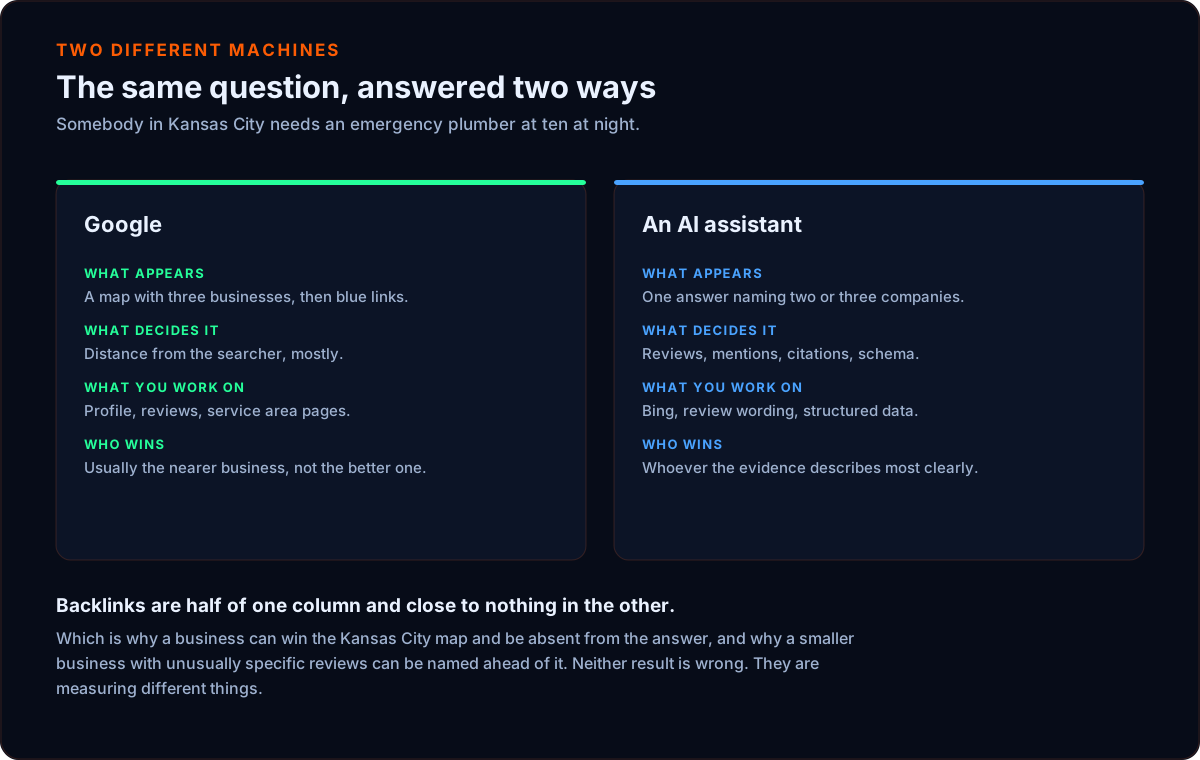
Take a straightforward one. Somebody in Kansas City needs an emergency plumber at ten at night.
On Google. A map pack appears with three businesses, chosen mostly by how close they are to the phone, then blue links underneath. Local search is doing the work, and the business two miles away usually beats the better business ten miles away. Whoever has done the profile and the local SEO properly is in with a chance.
In an assistant. No map loads. The system produces two or three names with a sentence each about why. It got those names from reviews that described emergency callouts, from directory listings that confirm the business exists and what it does, and from threads where somebody asked the same question. Distance barely features.
Which is why the two can disagree completely. A business winning the map can be absent from the answer, and a smaller business with unusually specific reviews can be named ahead of it. Neither result is wrong. They are measuring different things.
The practical consequence for any business in Kansas City is that you cannot infer one from the other. Checking your Google rankings tells you nothing about whether assistants name you, and the only way to find out is to ask them and write down what comes back.
Where AI work and ordinary marketing services are the same work
Most of what improves AI search visibility is work a good digital marketing agency would already be doing, which is the strongest argument for doing it now rather than waiting.
Complete, consistent listings. Helps local search, helps the assistants, costs an afternoon. There is no version of the next five years where this is wasted.
Schema markup. Earns rich results on Google and gives AI platforms machine readable facts instead of inference. One job, two audiences.
Reviews with substance. Better for conversion, better for the map, and the only review format an assistant can actually quote. Changing what you ask for costs nothing.
Pages that answer real questions. The content that ranks in the blue links is the content that gets quoted. This is ordinary search engine optimization and it pays twice now.
A site that can be read. Clean markup, real headings, no key information locked inside images or scripts. That is web design doing its job, and a site built badly enough to confuse a crawler will confuse an assistant too.
What does not overlap is the community and mention work, which is slow, genuinely separate, and the part that costs real time. We will help businesses decide whether that last piece is worth it yet, and for plenty of the Kansas City market the honest answer this year is not quite.
What marketing solutions in this area should and should not cost
Because the field is new, the pricing is wild, and some of what is being sold to the Kansas City market is a rebadged version of work that has existed for a decade.
Worth paying for. Listings and schema as part of a wider engagement. Review process changes. Prompt testing and reporting so you know where you stand. Content built to answer questions properly.
Be careful with. Anything sold as guaranteed placement in AI answers. Any digital agency charging a large separate retainer for what is mostly listing hygiene. Tools promising to submit your business to AI systems, which is not a thing that exists.
Our position. This belongs inside a search engagement rather than beside it, priced as part of the scope, because most of the work is shared. If somebody is quoting you a standalone AI package that costs more than your SEO, ask which parts are not already in your SEO.
The realistic split for a Kansas City business today is most of the budget on the channel that provably converts and a slice on the one that is growing. Everything we run here is on the Kansas City services page.
Questions Kansas City business owners ask about AI search
Alongside the classic work, yes, because most of it costs little and overlaps with things worth doing anyway. Instead of the classic work, no. We would rather say that than sell it as a replacement, and if a Kansas City agency is pitching it as the main event, ask what their evidence is.
Because several assistants read Bing's index when answering questions about local businesses. A business missing from Bing is missing from those answers regardless of how it performs on Google. It is free, it takes an afternoon, and most Kansas City businesses have never done it.
Far less than they help on Google. These systems lean on mentions, citations, structured data and review content. An unlinked mention in a local news piece can matter more than a link, which is the opposite of how classic SEO works.
No. Anyone who says yes is describing something that does not exist. The systems are opaque and change constantly. What we can do is make your business the obvious answer to name, then test the prompts and report whether it happens.
By testing the prompts your customers would actually use and tracking how often you appear and what gets said. Assistant traffic largely does not show in Search Console, so anyone claiming to report it from there is reporting something else.
No. The map pack is still where most local clicks go in Kansas City today. AI search is an additional front, not a substitute, and the honest split is most of the budget on the proven channel and a slice on the growing one.
Sources
1. Google Search Central, "AI features and your website" https://developers.google.com/search/docs/appearance/ai-features
2. Google Search Central, "Do You Need an SEO?" https://developers.google.com/search/docs/fundamentals/do-i-need-seo
3. Google Business Profile Help, "Improve Your Local Ranking on Google" https://support.google.com/business/answer/7091
4. U.S. Census Bureau, QuickFacts: Kansas City, Missouri https://www.census.gov/quickfacts/kansascitycitymissouri
Want to know if AI search names you?
We will run the prompts your customers would use and show you what comes back, including when the answer is a competitor.