Why most e-commerce product pages never rank
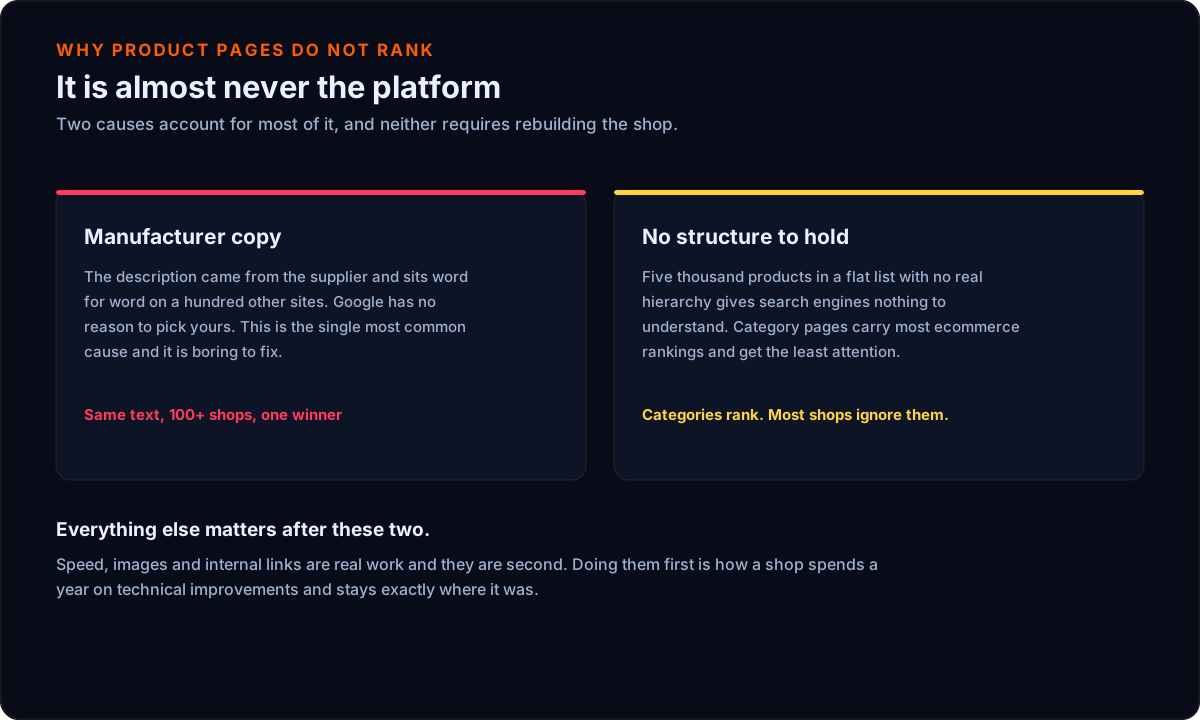
It is almost never the platform and almost always the same two things, and both are fixable without rebuilding the shop.
The descriptions came from the manufacturer. That copy is sitting on a hundred other sites word for word, which gives Google no reason to pick yours. This is the single most common reason a product page sits invisible, and it is boring to fix and it works.
There is no structure to hold onto. Five thousand products in a flat list with no real category hierarchy gives search engines nothing to understand. Category pages, not product pages, are what usually carry e-commerce SEO, and most shops treat them as a grid with a heading.
Everything else, speed, images, internal links, matters after those two are dealt with. Doing them in the other order is how a shop spends a year on technical work and stays where it was.
E-commerce SEO for Kansas City online retailers
Ordered by what actually moves revenue, not by what is most fun to report on.
Unique product copy
Written per product, about the product, for the person deciding. At scale this is the expensive part and it is also the part that works.
Category architecture
A hierarchy that matches how people shop rather than how the warehouse is organized. Category pages are usually the real money pages.
Product structured data
Price, availability, currency and condition marked up properly so the listing can earn a rich result. Google documents exactly what is required.3
Review markup, done legitimately
Ratings from reviews collected on your own site. We do not mark up reviews scraped from third-party platforms, because that is against Google's guidelines and the penalty lands on the shop.
Variant handling
Size and color as one canonical product rather than forty near-duplicate pages competing with each other and splitting their own signal.
Speed at scale
A shop with thousands of images has a different performance problem from a brochure site, and the fixes are different too.
Selling online from Kansas City is two jobs
Most Kansas City shops we work with are doing both at once and had not separated them, which makes the reporting confusing and the strategy muddled.
The national side is classic search engine optimization. Deeper category content, unique product copy, links, and patience. Distance is irrelevant, competition is everybody, and the work compounds slowly.
The local side still exists if people can collect, visit a showroom or buy locally. That is a map pack fight and a completely different set of levers, laid out on our Kansas City local SEO page.
They need separate keywords, separate pages and separate reporting. Merging them produces a plan that half serves both. And if the store platform itself is the constraint, that conversation starts at web design.
The full set of services for this metro is on the Kansas City internet marketing page.
What an e-commerce SEO engagement does, in order
Shops are different from service sites because the work has to scale across thousands of URLs, which means order of operations decides whether the budget lands. This is the sequence we run.
One, the audit and the analytics. Before anything is written we establish what already earns. Which categories bring revenue, which products get impressions and no clicks, what the search terms are, and whether the tracking is even correct. A surprising share of ecommerce analytics we inherit is double counting transactions, and every decision made on top of that is wrong with confidence.
Two, the category layer. Category pages do most of the ranking in ecommerce and get the least attention. They usually need real copy, an internal linking structure that makes sense, and a hierarchy matching how customers shop. This is the highest return work in the whole engagement and it is also the least glamorous.
Three, the technical layer. Crawl budget, faceted navigation generating infinite URLs, variants competing with each other, pagination, speed. Technical SEO on a shop is a different discipline from technical SEO on a brochure site because the scale changes what breaks.
Four, product copy at scale. Prioritized by revenue rather than alphabetically. Drafted with AI, edited by a person, and checked against the actual product so the description is true.
Five, the ongoing work. New products need the same treatment. Seasonal categories need refreshing. Content marketing around the buying questions brings people in above the transaction, which is where most shops never bother and where the cheapest growth usually sits.
E-commerce SEO alongside everything else
Search optimization for a shop rarely works alone, and any SEO company saying otherwise has not run one.
Paid search covers the season. Retail demand spikes and organic rankings do not move fast enough to catch a spike that arrives in six weeks. Google Ads and shopping campaigns take the peak while the organic work compounds underneath. A digital marketing agency that will not run both is optimizing for its own convenience.
The platform sets the ceiling. If checkout is slow or the category templates cannot take copy, the SEO service is capped by the build. That is a web design conversation and it is better had early.
Social media marketing does something different. It builds demand for products people did not know existed, which search cannot do because search requires somebody to already be looking. For a Kansas City shop selling something genuinely novel, that ordering matters.
Local still applies if people can collect. Separate pages, separate keywords, separate reporting, set out at Kansas City local SEO.
These are not marketing solutions sold as a bundle. They are four jobs, and we would rather help businesses buy the one or two that actually apply than sell a package with two dead components in it.
The whole set for this metro is on the Kansas City page.
How to compare ecommerce SEO agencies without a technical background
Shops get pitched by more agencies than anyone, and the proposals are hard to compare because half the vocabulary is invented. These questions cut through it and none require you to understand the answer technically.
"Which of my pages makes the most money, and what would you do to it first?" Anybody who has looked at your shop can answer this in a sentence. Anybody who has not will talk about digital strategies instead. It is the fastest filter there is.
"Are you optimizing products or categories first?" Categories, almost always, because they carry most ecommerce seo traffic and get the least attention. An answer that starts with product pages suggests a template rather than a plan.
"What on-page SEO will you change, and can I see it before it goes live?" Titles, headings, descriptions and internal links on a live shop can break things. You should get a preview, not a surprise.
"What do you do about duplicate manufacturer copy at scale?" The honest answer involves prioritizing by revenue and accepting that not everything gets rewritten in month one. An agency promising all five thousand descriptions is describing a budget, not a plan.
"What will you not do?" Useful everywhere, essential here. Our answer includes marking up reviews we did not collect, and buying links, and migrating a platform that is working fine.
Where search sits among the other things a shop is doing
Search is one input into your digital presence rather than the whole of it, and the marketing strategies that work for retail usually run three things at once.
Search brings people who already want it. That is its strength and its ceiling. Nobody searches for a product category they have never heard of, so search can only ever capture demand that exists.
Social media management creates demand that did not exist. For a shop selling something genuinely new, this has to come first or search has nothing to catch. It is a different discipline with different people doing it, and we would rather say that than pretend one team is excellent at both.
Paid keeps the season. Retail demand arrives in spikes that organic rankings cannot turn fast enough to meet. Shopping and search campaigns take the peak while the slower work compounds underneath it.
Most ecommerce SEO agencies will sell you whichever of those three they happen to staff. The useful question is which ones your business actually needs this year, and the answer is rarely all three at full weight.
What we run across this metro, and the market data behind it, is on the Kansas City page. The general search work is at Kansas City SEO services.
Questions Kansas City online retailers ask
Usually because the descriptions came from the manufacturer and sit identically on dozens of other sites, and because the category structure gives Google nothing to hold onto. Those two account for most of it. Platform choice almost never does.
Not on day one. Start with the products that carry the revenue and the categories above them, because category pages usually do the ranking anyway. Rewriting five thousand descriptions before measuring anything is how budget disappears.
Only from reviews collected on your own site. Marking up ratings pulled from third-party platforms breaks Google's guidelines and the penalty lands on your shop, not on whoever suggested it. We will not do it, including if asked.
All of them can rank. None of them rank on their own. We have no platform allegiance and we will not recommend a migration unless the current one is genuinely blocking the work, because a migration is a risk you take on with no ranking upside.
Badly, when every size and color becomes its own indexable page. They compete with each other, split whatever authority exists and dilute the signal. Handled properly they are one canonical product with options.
Only if people can collect, visit or buy locally. If so it is a separate job with separate pages and separate tracking. If you ship nationally and nothing else, skip it and put everything into the organic work.
Sources
1. Google Search Central, "Product structured data" https://developers.google.com/search/docs/appearance/structured-data/product
2. Google Search Central, "Do You Need an SEO?" https://developers.google.com/search/docs/fundamentals/do-i-need-seo
3. Google Business Profile Help, "Improve Your Local Ranking on Google" https://support.google.com/business/answer/7091
4. U.S. Census Bureau, QuickFacts: Kansas City, Missouri https://www.census.gov/quickfacts/kansascitycitymissouri
Want to know why your products are invisible?
We will look at your category structure and a sample of product pages and tell you which of the two problems you have.