Billboard Advertising in Kansas City, MO
A board on I-435 reaches the same drivers who search for you later that week. We plan the routes, buy the faces, build the creative and measure the lift in your search data instead of handing you an impressions figure nobody can act on.
What billboard advertising in Kansas City actually buys
A digital billboard is a lit screen beside a road running your artwork in a rotation with a handful of other advertisers. Each one holds the face for roughly eight seconds before the loop moves on, which means the same commuters see you many times a week rather than once.
That repetition is the entire product. Outdoor advertising does not work like paid search, where somebody types a need and you answer it. It works by making your name familiar before the need exists, so that when the water heater fails your business is the one already in their head.
Which is why we measure it in search data rather than in impressions. An impressions figure is a number nobody can act on. A lift in people searching your business name during a flight is a number you can.
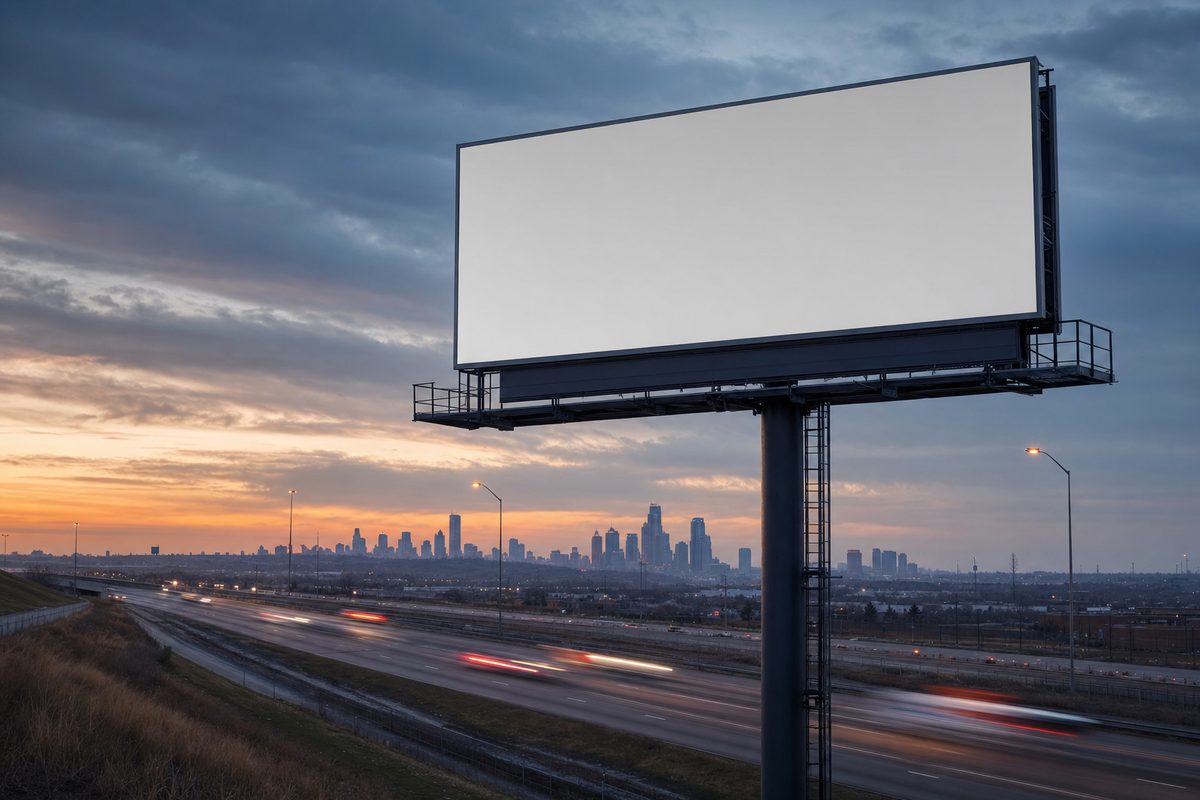
The Kansas City corridors worth buying
Kansas City is a highway city, and that shapes outdoor buying more than in most metros. The interstates carry the volume, and the decision is almost always about which flow of traffic contains your customers rather than which board looks biggest.
I-70 runs the metro east to west and carries both commuter traffic and through traffic crossing the state. I-35 cuts south west toward Overland Park and Olathe. I-435 is the loop, which means it reaches suburban traffic that never goes downtown, and for a lot of home service businesses that is the more valuable audience. I-29 carries the northland and airport traffic, and US-71 runs the south corridor.
Which of those matters depends entirely on where your customers live and how far they will drive to you. A roofing company serving Lee's Summit and a restaurant downtown want opposite sides of the same map. Missouri publishes its traffic volume data, so the counts in a proposal are checkable rather than something you take on trust.2
We plan the routes, buy the faces, build the creative and measure the lift. We do not own structures, which matters because it means we have no reason to push you toward a particular board.
The kinds of boards you can buy around Kansas City
Different jobs. The cheapest option is rarely the cheapest per customer.
Digital bulletins
The large highway screens. Highest reach, shortest commitment, and you can change artwork without a print run. Best where volume of traffic is the point.
Static bulletins
Printed and yours alone for the whole flight, no rotation. Better for a single message you want owned rather than shared.
Posters
Smaller formats on surface streets. Lower reach per face, much better for saturating one neighborhood rather than one highway.
Transit and street furniture
Buses, shelters and benches. Slower exposure, closer to pedestrians, useful for businesses whose customers walk past rather than drive by.
Creative production
Seven words is roughly the limit at highway speed. The design is not a shrunk down flyer and treating it as one wastes the buy.
Measurement
Branded search volume, direct traffic and call volume tracked against the flight window. Not an impressions figure.
The questions worth asking before booking a Kansas City billboard
Is your Google profile finished? This is the one we are strict about. A board creates demand and hands it to whoever is easiest to find. If somebody sees your name on I-435, searches it, and your listing is half built with the wrong hours, you have paid to introduce a customer to a competitor. We will not run outdoor for a business whose profile is not ready, and fixing it is the cheap part.
How long is the flight? Two weeks on a board is not advertising, it is a souvenir. Familiarity is built by repetition, and short bursts buy the cost without the effect.
What does the artwork say? Seven words, a legible name, and one reason to remember it. No phone number nobody can write down at seventy miles an hour.
What are you measuring? Decide before it goes up. Branded search lift and call volume against the flight window is the honest measure, and it is only available if somebody recorded the baseline first.
Rates depend on the corridor, the format and the flight length, and anyone quoting a Kansas City billboard price without asking which road is guessing. We quote per corridor after the conversation about who your customers are. The rest of what we run here is on the Kansas City services page.
How billboard locations get chosen, and what a proposal should show
The temptation is to buy the board you personally drive past. It is almost never the right one, because you are not your target audience and your commute is not theirs.
A proper proposal starts from where your customers live and work, then finds the high-traffic routes between those places and yours. Sometimes that is a major highway, and sometimes it is a surface street near a retail cluster where people are already slowing down. For a home services business the loop road that never goes downtown often beats the glamorous interstate face, because that is where the households are.
What a billboard proposal should show you. The specific billboard locations with their traffic counts, the direction of travel, the read time at the posted speed, what else is competing for attention at that spot, and the flight dates. Missouri publishes traffic volume data, so those counts are checkable rather than something to take on faith.2
What it should not do. Quote a package before asking who your customers are. A price given without a corridor is a price for a board somebody needs to sell, not a board you need to buy.
Questions Kansas City business owners ask about billboards
It depends on the corridor, the format and how long you run, and anyone quoting a figure before asking which road is guessing. A digital face on an interstate and a poster on a surface street are different products with different economics. We quote per corridor once we know who your customers are and where they drive.
They do different jobs. Digital shares the face with other advertisers in a rotation but gives you reach and the ability to change artwork. Static is yours alone for the whole flight, which suits one message you want to own. Neither is better in the abstract.
Branded search volume, direct traffic and call volume measured against the flight window, with a baseline recorded before it goes up. Impressions figures are supplied by the industry and cannot be acted on. If nobody captured the baseline, the honest answer afterward is that you cannot tell.
No, and that is deliberate. We buy faces on your behalf from the companies that own the structures, which means we have no reason to steer you toward a particular board. A vendor who owns inventory always has one.
Long enough for repetition to do its work, which is the whole mechanism. Two weeks buys the cost without the effect. We would rather run fewer faces for longer than more faces briefly.
After, and we are firm about this one. Outdoor advertising sends people to search for you. If what they find is a half finished Google profile or a slow website, you have paid to hand a customer to whoever looks more organized.
Indirectly and genuinely. More people searching your business name is a signal, and brand familiarity makes every other channel convert better. It is not a substitute for search work, it is what makes search work land harder.
Sources
1. Missouri Department of Transportation, Traffic Volume Maps https://www.modot.org/traffic-volume-maps
2. Out of Home Advertising Association of America, Industry Research https://oaaa.org/resources/research/
3. Google Business Profile Help, "Improve Your Local Ranking on Google" https://support.google.com/business/answer/7091
4. U.S. Census Bureau, QuickFacts: Kansas City, Missouri https://www.census.gov/quickfacts/kansascitycitymissouri
Want rates for your corridor?
Tell us who your customers are and where they drive, and we will come back with the roads worth buying.